Language
  EN
EN RU
RU ES
ES DE
DE EL
EL IT
IT JA
JA KO
KO PT
PT ID
ID SR
SR UK
UK VI
VI TH
TH TR
TR MS
MS BE
BE AR
ARBosch 0445116018 Piezo Common Rail Injector: Euro 6 Heavy-Duty Testing & Repair Guide
Bosch 0445116018 Piezo Common Rail Injector: Euro 6 Heavy-Duty Testing & Repair Guide
If you service Mercedes-Benz Actros MP4, MP5, Antos or Arocs trucks running the OM471 Euro 6 engine, the Bosch 0445116018 piezo injector is one of the part numbers you will see most often. This piezo common rail injector belongs to Bosch's CRIN3 generation and is fundamentally different from the older solenoid CRI2 injectors we covered in our 0445110183 guide. In this article we walk through the technical features that make piezo injectors special, the most common failures our customers report on Euro 6 trucks, a real diagnostic case from our service records, and the test bench setup you need to handle 200 MPa-plus rail pressure correctly.
1. What is the Bosch 0445116018?
The 0445116018 is a piezo-actuated common rail injector from Bosch's CRIN3 family. It uses a stack of piezoelectric crystals instead of a solenoid coil to open the nozzle, which lets it switch up to five times per injection event - a capability the older CRI2 solenoid design physically cannot match. It is fitted on the Mercedes-Benz OM471 inline-6 Euro 6 engine, which powers Actros MP4 (2011-onward), Actros MP5, Antos and Arocs heavy-duty trucks across Europe, the Middle East and Latin America. A close sibling is the 0445116045 used on the same OM471 platform for the higher-output 12.8L version.
2. Piezo vs Solenoid: What Actually Changes
From the workshop bench perspective the differences between a CRI2 solenoid injector like the 0445110183 and a CRIN3 piezo injector like the 0445116018 fall into three categories:
• Drive signal: solenoid injectors run on a single 12V/110V pulse; piezo injectors need a 50-200V high-voltage driver stage that charges and discharges the piezo stack in microseconds. A standard CRI2 test bench will not drive a CRIN3 nozzle.
• Injection events per cycle: solenoid = 1 pilot + 1 main max; piezo = up to 5 (multiple pilots + main + after). This is the whole point of Euro 6 - finer rate shaping for lower NOx and particulate.
• Nozzle mechanics: piezo stack directly actuates the needle via hydraulic coupler, no magnetic coil, no return spring force to fight. The result is faster response but also tighter tolerances - the reference injection volume windows for the 0445116018 are typically 1-3 cm³ at idle pilot and 8-12 cm³ at full load, with a backflow window of 4-8 cm³ that must be measured separately.
3. Common Failures & Repair Cases on Euro 6 Mercedes
The single most frequent service complaint we receive for the 0445116018 is: "My customer is showing a P0201-P0206 fault code and the truck derates - the injectors look fine on the old solenoid test bench, but the fault returns after a short drive." This exact wording is in our after-sales Q&A database (case #214) and is the textbook symptom of one of three root causes:
3.1 Piezo stack fatigue after 250,000 km
The piezo crystals lose polarization over thermal cycles. The injector still opens mechanically, but the actuation voltage rises from a baseline of 110V to 150-180V. On the truck ECU this reads as "injector response too slow" and triggers derate. The diagnostic step is to measure the charging voltage curve on the bench, not just the injection volume.
2.2 Hydraulic coupler micro-leak
The hydraulic coupler between the piezo stack and the needle is filled with a special oil. If it leaks (visible as fuel in the return line mixed with coupler oil), the actuation force drops and the injection volume falls off at high rail pressure. Re-sealing the coupler requires Bosch factory tooling - on a workshop bench this is usually a "replace injector" verdict.
3.3 Nozzle seat wear from EGR soot
Euro 6 trucks run cooled EGR, which puts soot into the combustion chamber. After 200,000+ km the nozzle seat wears and backflow rises above the OEM 8 cm³ window. This is a mechanical repair, not an electronic one - a properly equipped bench can identify it within 5 minutes by running the standard backflow test at 1500 / 2000 / 2500 bar pilot + main.
4. Recommended Test Bench Setup
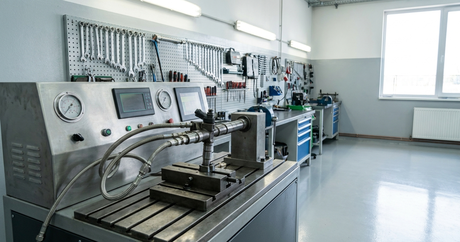
Because the 0445116018 needs both standard CR solenoid testing and high-voltage piezo driving, it requires a bench with piezo capability enabled. The minimum recommended setups in the Beacon catalog are:
• Workshop floor: CR919A - 15KW, four-motor drive, large cam box, piezo function built in (no extra charge). The CR919A also handles EUI EUP and HEUI in the same chassis if your shop services mixed Euro 6 truck fleets.
• Mid-size shop: CR918-S / CR918-PRO - 22KW servo motor, piezo standard, both DRV stages, optional cam box for EUI EUP. The CR918-PRO is the most common Euro 6 truck bench we ship to Eastern Europe and the Middle East.
• Mobile / small workshop: EPS206 / EPS206-PLUS - 2.6KW desktop unit with built-in piezo driver and BIP sensor. Covers all CRIN3 injectors including the 0445116018, but backflow measurement accuracy is lower than the full-size benches due to the smaller flow sensor.
Whichever bench you choose, make sure your Bosch data card includes the 0445116018 reference values: pilot + main injection volume at 1500 / 2000 / 2500 bar, backflow window, charging voltage curve, and the IMA coding for Bosch 8-10 digit. If your card is pre-2019, request an updated one from Beacon before testing.
5. Frequently Asked Questions
Q1: Can my old EPS118 test the 0445116018?
No. The EPS118 does not support piezo drive voltage and lacks the high-voltage driver stage required for CRIN3. The minimum upgrade is to an EPS205 (solenoid only) plus an external piezo kit, or directly to an EPS206 which has piezo built in. The EPS118 has been out of production for several years and we do not recommend retrofitting it.
Q2: The customer's existing CR708 has piezo on the sticker - will it test 0445116018?
Yes, the CR708 / CR708L / CR708T all include piezo as standard, and the 0445116018 is in the default Bosch data card. Make sure the data card version is 2019 or later (older cards have CRI2 reference values but no CRIN3 entry). If your card is older, the bench will report "injector not in database" - we can ship an updated card free of charge.
Q3: How do I distinguish a CRIN3 piezo failure from a wiring harness fault?
The bench must support impedance measurement on the piezo stack. A short circuit below 1 kΩ means harness damage; an open circuit above 1 MΩ means the piezo stack has fractured. Values in between (10-500 kΩ) indicate the stack is alive but fatigued. Only the CR919A and CR918-S / CR918-PRO benches in our catalog include this impedance test as standard; on smaller benches you can identify a piezo failure by comparing injection volume at 1500 bar versus 2500 bar - a fatigued stack drops more than 15% across that range.
About Beacon Machines
Beacon Machines has been manufacturing diesel injector test benches, common rail pumps, and diagnostic equipment for the aftermarket since 2008. Our 90+ machine models cover CR / HEUI / EUI EUP / PT across all major OEM families. Every product ships with a one-year warranty and lifetime remote diagnostics.
 Beacon Machine Manufacturing Co.,ltd.
 about beacon
PRODUCTS
contact us
TEL: 0086-18253885138
WhatsApp:+86-18253885138
Email: Janechen@beacon-machine.com
Add: High Tech Industry Zone of East Tai an city,Shandong Province,China