Language
 EN
 RU
 ES
 DE
 EL
 IT
 JA
 KO
 PT
 ID
 SR
 UK
 VI
 TH
 TR
 MS
 BE
 AR
Denso HP0 Fuel Pump Guide: Komatsu SAA6D140E-3 Testing & Repair
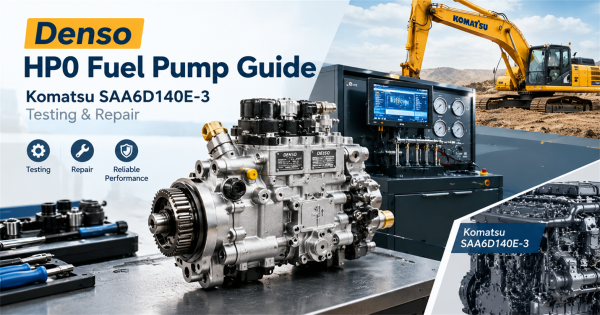
Denso HP0 Fuel Pump Guide: Komatsu SAA6D140E-3 Testing & Repair
The Denso HP0 pump is a high pressure common rail supply pump built for heavy off highway engines, and the 094000-0342 version is one of the most common units in the field because it sits on every Komatsu SAA6D140E-3 powered machine - the PC650, PC750 and PC800 excavators and the D275 bulldozer series. Workshops outside the dealer network see these units regularly, and the failure pattern is quite different from a passenger car pump. This guide covers how the HP0 is built, how it fails in service, and what a workshop needs on the bench to test it properly. If you are setting up HP0 capability, talk to us on WhatsApp and we will match the right bench and adapters for your machines.
1. How the Denso HP0 Pump Is Built
The HP0 is a radial piston supply pump. A drive shaft carries an eccentric cam, and a triangular ring cam rides on that eccentric. Three plungers are mounted on the ring cam at 120 degree intervals, so each shaft revolution produces three pumping strokes. This is the same basic layout Denso uses across its HP series, scaled up for the fuel volume a large displacement off road engine needs.
Fuel delivery is controlled on the suction side by the SCV, the suction control valve. The SCV regulates how much fuel is allowed into the plunger chamber, and the ECU uses it to hold rail pressure at the target value for the current load. That means the pump itself does not decide how much fuel goes to the injectors - it only builds pressure, and the ECU trims it through the SCV. The feed pump is driven from the rear of the same shaft and supplies low pressure fuel to the SCV.
Three details matter for anyone working on these units:
The 094000-0342 is rated at 1800 bar working pressure, which is modest by modern passenger car standards but is delivered at a much higher flow rate.
The pump is cam driven and mechanically timed, so it can only be tested on a bench that drives the shaft at controlled speed.
There are three plungers and three delivery paths, so a single worn plunger shows up as a pressure drop rather than a complete failure.
2. Applications and Identification
The HP0 family covers a wide range of off highway and industrial engines. These are the references that come up most often in workshop enquiries.
| Pump number | Komatsu reference | Engine / machine |
|---|---|---|
| 094000-0340 | 6218-71-1110 | SAA6D140E-3, PC800 series |
| 094000-0341 | 6218-71-1110 | SAA6D140E-3, PC750 |
| 094000-0342 | 6218-71-1111 | SAA6D140E-3, PC650-8, D275A |
| 094000-0440 / 0441 | 6218-71-1130 / 1132 | SA6D140E-3, later production |
| 094000-0161 | - | Isuzu 6HK1, Hitachi series |
When a customer sends a pump number that is not on this list the fastest route is to search the number in an online parts catalogue and read back the machine application. The two yellow solenoid connectors on top of the pump body are the practical field identifier for the HP0 family - if the unit has them, it is a radial piston HP pump and needs HP0 test capability, not a standard inline pump test.
3. Common HP0 Failures
Fuel contamination and SCV sticking
The SCV is the most frequent failure point. Because it meters fuel on the suction side, any debris, water or bacterial growth in the tank ends up sitting on the valve seat. A sticking SCV produces erratic rail pressure, hunting idle and a derate that comes and goes. On Komatsu machines this often appears as a pressure related fault code with no obvious mechanical noise. Cleaning or replacing the SCV fixes a large share of these complaints before any pump work is needed.
Plunger and cam ring wear
All three plungers and the ring cam run in diesel fuel with only the fuel film for lubrication. At high hours, fine contamination polishes the plunger bores and the cam contact surfaces. The result is internal leakage: the pump can no longer hold rail pressure under load, so the machine feels weak, smokes and needs longer cranking. Wear is usually uneven across the three plungers, which is why a pressure and delivery test is more informative than a visual inspection.
Seal and drive end problems
Fuel dilution of the engine oil, external seepage at the pump flange and wear in the drive coupling are the other common issues. A pump that passes a pressure test but leaks at the shaft seal still has to come off, and the seal kit should be replaced together with the plunger check rather than on its own.
4. Test Bench Setup for HP0 Work
HP0 testing has two requirements that a basic injector bench does not meet: the bench has to drive a pump shaft at controlled speed, and it has to measure delivery and pressure at 1800 bar. The machines below all include HP0 pump function as standard equipment, so no extra option is needed to test an 094000-0342.
| Machine | Positioning | Why it fits HP0 work |
|---|---|---|
| CR919A | Full function flagship | Injector, pump and HP0 function in one unit, highest flow capacity |
| CR917S | Full function | High rail pressure with HP0 pump function, popular for mixed fleets |
| CR1029 | Common rail bench | Comprehensive CR performance bench with HP0 capability |
| CR1028 | Common rail bench | Injector and pump testing including HP0 |
| CR1016 | Common rail bench | Workshop level CR bench with pump function |
| CR1017-PLUS | Common rail bench | Workshop coding platform with HP0 pump function |
| CR819 / CR819S | Mid range | Injector and pump bench, HP0 included |
| CR301 | Compact CR bench | Entry level CR bench with HP0 pump function |
Two practical notes. First, the adapters and delivery pipes are not universal - a Komatsu HP0 needs the correct flange and pipe set, so confirm the pump number with us before shipping. Second, if you also service passenger car common rail pumps, choose a bench that covers both rather than adding a dedicated HP0 station. Our team can check your pump list against the bench specification on WhatsApp.
5. HP0 Test and Repair Workflow
Record the complaint and read fault codes. Rail pressure deviation, hard starting and derate are the usual three. Note whether the fault is temperature or load dependent.
Check the low pressure side first. Feed pressure, filter restriction and tank contamination cause more HP0 symptoms than the pump internals do.
Inspect the SCV. Remove it, check the seat for debris and measure the coil. Replace the seal kit and refit before condemning the pump.
Run the pump on the bench. Mount with the correct adapter, drive at the specified speeds and record delivery and pressure at several points, not just at full load.
Strip and measure. Check plunger to bore clearance, cam ring contact pattern and shaft seal. Replace the plunger set as a matched assembly, not one plunger at a time.
Reassemble, bench test again, then fit. After installation, delete adaptations where the machine requires it and verify rail pressure holds under load before releasing the machine.
A useful diagnostic habit: many HP0 complaints that look like pump failure turn out to be injector return flow or a rail pressure sensor offset. Check injector leak off before stripping a pump that has no measurable internal leakage on the bench.
6. Frequently Asked Questions
Can I test an HP0 pump on an injector only test bench?
No. An injector bench has no controlled pump drive and no delivery measurement, so it cannot verify the 094000-0342. You need a bench with pump function, meaning a machine that drives the pump shaft at set speeds and measures delivery and pressure.
Does an HP0 pump need coding after repair?
The pump itself does not carry an injector style correction code. What matters is that rail pressure control is re learned by the ECU after fitting, and that the SCV is functioning correctly. Injectors from the same engine do carry correction codes and are a separate topic.
What is the most common cause of low rail pressure on a Komatsu HP0 system?
In our experience the order is: restricted fuel supply or filter, sticking SCV, excessive injector return flow, and only then internal pump wear. That order is also the cheapest to check first.
About Beacon Machines
Beacon Machines builds diesel fuel injection test benches for workshops that service common rail, EUI, EUP, HEUI, PT and mechanical pump systems. Our range covers compact single function benches through to full function machines that handle injectors, high pressure pumps and off highway units like the Denso HP0 on one platform. Every bench ships with training material and remote support, and we help customers select adapters for the exact pump and injector numbers they see in their market. To discuss HP0 capability, adapter sets or a full workshop configuration, contact our team on WhatsApp.
 Beacon Machine Manufacturing Co.,ltd.
about beacon
PRODUCTS
contact us
TEL: 0086-18253885138
WhatsApp:+86-18253885138
Email: Janechen@beacon-machine.com
Add: High Tech Industry Zone of East Tai an city,Shandong Province,China