Language
  EN
EN RU
RU ES
ES DE
DE EL
EL IT
IT JA
JA KO
KO PT
PT ID
ID SR
SR UK
UK VI
VI TH
TH TR
TR MS
MS BE
BE AR
ARDetroit Diesel Series 60 (DDC60) EUI/EUP Test Bench Guide: Features, Failures & Calibration
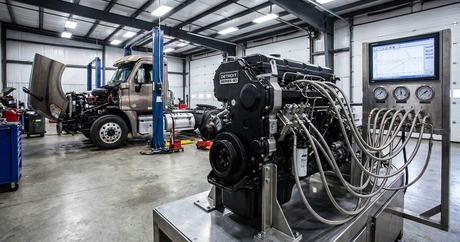
Detroit Diesel Series 60 (DDC60) EUI / EUP Test Bench Guide
The Detroit Diesel Series 60 — DDC60 to its fans — was the workhorse under the hood of Freightliner, Western Star, Peterbilt and Sterling Class 8 trucks from the late 1980s until Tier 4 took over. Two fuel systems keep showing up on the bench: the DDEC III / IV Electronic Unit Injector (EUI) and the earlier mechanical Electronic Unit Pump (EUP) used on MBE 900 / 4000 and early Series 60 11.1L / 12.7L engines. Both run on a cam-driven, jerk-pump principle, which is exactly why a small solenoid common rail test bench will not test them — the bench needs a real cam profile and the right adapter set.
1. What Exactly Is a DDC60 EUI or EUP?
A Series 60 EUI looks like a single, self-contained unit that bolts onto the cylinder head. Inside, the injector body is the high-pressure pump: the engine camshaft pushes a plunger up through a roller tappet, the spill valve opens or closes to meter the injection, and the solenoid on top tells the ECM when to fire. No high-pressure fuel lines, no separate rail. The later DDEC V and DDEC VI platform pushed the spill valve to a piezo actuator, but the 12.7L and 14L mechanical EUI you still see on the bench is 100% solenoid-controlled, jerk-pump style.
The EUP (Electronic Unit Pump) is its older brother. Each cylinder has its own pump mounted in the valley of the block, driven by a camshaft lobe and a push rod, with a short high-pressure line running up to a conventional mechanical injector. EUP shows up on MBE 900 / 4000 and on Series 60 11.1L / 12.7L pre-DDEC III. Same physical principle, just split into two pieces and easier to swap out individually.
2. Key Technical Features Worth Knowing
Cam-driven, not solenoid high-pressure — injection pressure is generated by the cam profile, not by a solenoid pressurizing a rail. This is the single biggest difference from a Bosch or Denso common rail injector.
Spill valve metering — the solenoid controls a spill valve that determines how much fuel stays in the plunger chamber vs. how much gets sent to the nozzle. Calibration is about timing of spill close, not about opening current.
Peak injection pressure ~30,000 psi (2,070 bar) on the EUI; EUP is similar. Way higher than a common rail solenoid injector and roughly on par with a piezo.
DDC60 EUI comes in two strokes — 12.7L (6× stroke 5.83 in) and 14L (6× stroke 6.61 in). Same body, slightly different nozzle flow and plunger diameter.
Two cam profiles on most EUI test benches — the faster / more aggressive profile (TU-D, "Detroit / Caterpillar / Delphi") and the slower Caterpillar 3406E profile (TU-C). You pick the cam box that matches the engine family you are rebuilding.
3. Common Failures & Repair Cases
3.1 Stretched solenoid coil (DDEC III / IV, 1990s trucks)
Coil resistance drifts from the spec 0.5 ohm up to 1.5 ohm after 800,000+ miles. The injector still fires but the ECM sees a weak signal and derates power. A proper EUI test bench shows the issue immediately on a coil-test routine; the truck-side symptom is "loss of power" and a flash code that won't go away.
3.2 Spill valve seat erosion
The spill valve closes against a hardened seat at the top of the plunger bore. Erosion is the number one reason a "good" EUI comes off the engine running rough and won't recalibrate. Bench test shows the symptom as a flat or reversed opening-pressure curve and high minimum delivery. The bench is also where you decide whether to reseat or scrap the body.
3.3 Nozzle coking (V8 12.7L and 14L)
Petroleum diesel at 14:1 AFR with EGR runs hot. Coking builds up around the nozzle holes and pushes the spray pattern off-center. DDC published a 0.5% minimum flow imbalance spec; a bench flow test catches it before the truck comes back two weeks later.
3.4 Broken plunger return spring
The EUI return spring sits in a sealed cup at the bottom of the unit. Salt-corrosion on Northern trucks cracks the spring in half. Bench test shows a "no delivery" or low delivery reading on the first stroke; visual inspection of the cup is the giveaway.
4. Why a Real Cam Box Matters for DDC60
You cannot test a DDC60 EUI on a common rail injector bench. There is no rail pressure to speak of — the cam is the high-pressure source. The bench must drive the EUI plunger through the same cam profile that the engine does, with the same ramp-up speed and dwell angle. That is what a cam box does.
The two cam boxes you actually need for DDC60 work are:
TU-D Cam Box for Bosch Caterpillar and Delphi EUI EUP Testing — the stock cam profile that ships standard with the CR919 / EUI EUP HEUI test bench. Covers Detroit Diesel Series 60 EUI and EUP out of the box, plus Caterpillar 3406E / C12 and Bosch / Delphi EUI EUP.
TU-C EUI EUP Cam Box for Diesel Fuel Injection Test Bench — a slower Caterpillar-friendly profile, useful when you are mixing Series 60 and 3406E work in the same shop.
Adapters matter too. The DDC60 EUI takes the 19-adapter set that ships with the EUI EUP HEUI bench (or 10-adapter on the smaller standalone EUI EUP-A). The EUP uses individual pump-and-line adapters per cylinder. Cheap Chinese adapter sets float around, but the bore tolerance on a DDC adapter is tight (the spill-valve port is only 2 mm), and a sloppy adapter will give you a false leak-down reading every time.
5. Why Simultaneous 8-Injector Testing Is the Real Time Saver
A DDC60 V8 rebuild is the bread and butter of any mid-size North American shop. Testing the EUIs one at a time, in sequence, with a single-cam-box rig, takes about 40 minutes per set of 8. That is the old way. A bench wired for simultaneous 8-injector testing — eight parallel high-pressure lines, eight solenoid drivers, eight cam positions, eight flowmeters — runs the whole V8 in one cam rotation. Total cycle time drops to 3 to 5 minutes per V8 set, and the flow readings line up side by side so a 0.5% imbalance jumps off the screen.
The Beacon CR919 EUI EUP HEUI Diesel Fuel Injector Test Bench supports simultaneous 8-injector testing as an option (system + 7 extra high-pressure lines + 14 solenoid valves + 14 filters + 1× eight-injector fixture), and the same is true for the smaller standalone EUI EUP-A Electronic Unit Injector and Unit Pump Repair Test Bench in its four- and six-injector configurations. Whether you go with the full CR919 or the bench-top EUI EUP-A, the simultaneous-test architecture is what makes a DDC60 V8 profitable to service in-house.
6. Recommended Test Bench Setup by Shop Size
Small / independent shop (1–2 trucks/week): standalone EUI EUP-A (7.5 kW, TU-D cam box standard, 19 adapters) covers 95% of DDC60 work and you can also add the four-injector simultaneous-test option later.
Mid-size fleet / rebuilder (3–6 trucks/week): full CR919 EUI EUP HEUI bench with TU-D standard + TU-C swap (≈ USD 1,000 difference) + 8-injector simultaneous test option. Lets you run a full V8 in 5 minutes.
Large rebuilder / OEM-style shop (10+ trucks/week): two CR919 benches, one set to TU-D for Detroit / Caterpillar, one set to TU-C for slower Caterpillar work; run V8 sets in parallel and bring cycle time below 3 minutes per set.
7. Frequently Asked Questions
Q: Can a regular Bosch common rail injector bench test a DDC60 EUI?
A: No. The EUI generates its own pressure from the camshaft. There is no rail to pressurize. You need a bench with a real cam box, a low-pressure fuel supply, and a solenoid driver that mimics the DDEC III / IV / V firing pulse. Anything else will either fail to fire the injector or give you nonsense readings.
Q: Do I need the TU-D and the TU-C cam boxes, or is one enough?
A: For Detroit Diesel Series 60 work, TU-D is the one you use 90% of the time. TU-C is worth adding if you also rebuild Caterpillar 3406E or other slower-lobe engines. The cam boxes swap out in about 10 minutes on the CR919.
Q: What's the minimum adapter count I really need for a DDC60 14L V8?
A: Eight adapters (one per cylinder), all 19 mm hex, all the same part number on a 14L. The 12.7L uses a slightly different injector body, so keep that set separate. A 19-adapter kit covers both engines plus most Caterpillar 3406E work.
Q: My shop runs mostly HEUI (Ford Powerstroke, Caterpillar C7/C9). Can I share cam boxes with EUI work?
A: No, HEUI uses a different test path entirely — it is oil-pressure driven (HEUI = Hydraulically actuated Electronically controlled Unit Injector). HEUI is tested on a CR919 with the dual oil-circuit HEUI option, which is a separate module from the EUI EUP cam box. Smaller desktop CR-and-piezo-only benches are out of scope for both EUI and HEUI.
About Beacon Machines
Beacon Machines has been building diesel fuel injector test benches since the early 1990s, with models shipping to more than 90 countries. The CR919 EUI EUP HEUI test bench is our flagship for heavy-duty work — cam-driven injectors, simultaneous multi-injector testing, and a cam-box swap path that lets a single bench cover Detroit Diesel Series 60, Caterpillar 3406E / C12, and the Bosch / Delphi EUI EUP family. Reach our technical team directly on WhatsApp for sizing help, adapter kits, or a quote on a specific configuration.
 Beacon Machine Manufacturing Co.,ltd.
 about beacon
PRODUCTS
contact us
TEL: 0086-18253885138
WhatsApp:+86-18253885138
Email: Janechen@beacon-machine.com
Add: High Tech Industry Zone of East Tai an city,Shandong Province,China