Language
  EN
EN RU
RU ES
ES DE
DE EL
EL IT
IT JA
JA KO
KO PT
PT ID
ID SR
SR UK
UK VI
VI TH
TH TR
TR MS
MS BE
BE AR
ARBosch CP1H vs CP4 vs Denso HP3: What the High-Pressure Pump in Your Test Bench Actually Does
Bosch CP1H vs CP4 vs Denso HP3: What the High-Pressure Pump in Your Test Bench Actually Does
If you've ever looked inside a common rail test bench, you've seen a high-pressure (HP) pump bolted to one side of the frame, plumbed to the injector manifolds via steel lines that look like they could hold back a fire hose. Most bench buyers never ask what that pump is or why it matters — they ask about injectors, profiles, pressure range, and software.
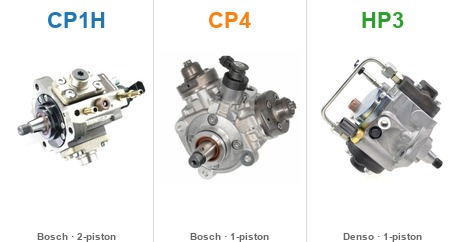
That HP pump is the heart of the bench. The choice between Bosch CP1H, Bosch CP4, and Denso HP3 shapes what your bench can test, how fast it builds pressure, how loud it runs, and how long it lasts. This post walks through what each pump does, where they differ, and what that means when you evaluate a test bench for your workshop.
Why the HP pump matters more than the spec sheet suggests
A common rail test bench isn't just a way to drive injectors. It's a way to recreate the conditions inside a real engine's fuel system. The HP pump is what creates those conditions:
It pulls diesel from the bench tank
It compresses it to working pressure (typically up to 1800–2500 bar, depending on the system being simulated)
It holds that pressure steady while the injectors fire, so you can measure return flow, spray pattern, and opening pressure under realistic load
The pump's design determines three things that show up in everyday bench work:
How fast pressure builds — relevant when you're cycling through 50 injectors a day and don't want a 10-second ramp every cycle
How stable pressure holds at the rail — relevant when you're measuring injector back-leak at 2000 bar
How much heat and noise the bench produces — relevant if the bench lives in a small workshop
The three pumps at a glance
**Note:** Pressure numbers above are typical for the pump type in production-vehicle use. Actual bench pressures depend on which system you're simulating — always verify against your specific injector datasheet.
Bosch CP1H: the workhorse for older light-duty system
The CP1H is a two-piston radial pump with an external camshaft. It was the standard HP pump on early light-duty common rail systems from the late 1990s through the mid-2000s. If your workshop services Toyota D-4D, early Isuzu common rail, or similar older platforms, you'll see CP1H-style behavior all the time.
On the bench, CP1H is the easiest pump to live with:
Pressure ramps smoothly — easier to teach new technicians because the gauge doesn't jump
Lower mechanical noise than CP4, which matters in a workshop that runs the bench 8 hours a day
Fewer peaky vibration events, so fuel line wear is gentler
Its limitation is upper-end pressure. If you're testing injectors from modern Bosch systems designed to run at 2000+ bar, CP1H-only benches struggle to reach and hold those pressures cleanly. That's where CP4-class pumps start to matter.
Bosch CP4: the modern standard for European diesels
The CP4 is a single-piston radial pump with an integrated cam ring. It's the HP pump you'll find on most modern Bosch common rail systems from 2007 onward — which means most European diesel passenger cars and a growing share of light commercial vehicles.
On the bench, CP4 changes the feel:
Pressure ramp is faster and more aggressive — you can hold 2000 bar and cycle injectors quickly, which matters for shops running 30+ injectors through a day
Mechanical noise is higher than CP1H — a noticeable "buzz" at working pressure that some operators find fatiguing over a full shift
Higher peak pressures are achievable — important when testing injectors from modern systems that expect to see rail pressures above 1800 bar during injection events
The trade-off is bench life. CP4-class pumps run harder, so seals, cam rings, and plunger surfaces wear faster than on a CP1H. A bench running CP4 for 8 hours a day needs more frequent preventive service than a CP1H-driven bench. This is normal for the technology, not a quality issue.
Denso HP3: the middle ground, especially for Asian-market work
The Denso HP3 is also a single-piston radial pump with an integrated cam ring, but it sits between CP1H and CP4 in operating character. HP3 is the pump you'll find on many Denso-equipped common rail systems, particularly in Toyota and several Asian-market platforms.
For a workshop that services a mix of European and Asian common rail vehicles, HP3 is often the practical choice because:
Pressure ramp is smoother than CP4 but faster than CP1H — a useful middle ground for technicians who run a variety of injectors through the same bench
Noise profile is gentler than CP4, similar to CP1H at low pressure, slightly higher at peak
Spare parts and service information are widely available if you're bench-testing Denso systems directly
If your shop's injector mix is roughly half Bosch and half Denso, an HP3-equipped bench is the most flexible single-pump solution.
What this means when you evaluate a bench for your shop
Three practical questions to ask before you commit to a test bench:
1. What injectors do you actually see?
If your daily work is older Toyota D-4D and similar light-duty common rail, a CP1H-equipped bench is sufficient and easier to live with. If most of your injectors come from 2010+ European diesels, you need CP4-class pressure. If you see a mix of European and Asian-market common rail, HP3 is the practical compromise.
2. How many hours a day does the bench run?
A bench that runs 4 hours a day on CP4 will give you years of service. The same bench running 10 hours a day, 6 days a week, will need seal and cam-ring service sooner. CP1H benches tolerate longer daily runs with less preventive maintenance. HP3 sits between.
3. What pressure do your injectors actually need?
This isn't always obvious from the injector part number alone. Pull three injectors you actually service, look up their nominal rail pressure in the OEM datasheet (or a service manual), and use the highest of the three as your benchmark. A bench that can hold that pressure with margin is the right one — not the bench with the highest peak pressure on the brochure.
How Beacon benches cover the three pump types
Beacon's injector test bench range covers the three pump profiles with different models designed for different workloads:
EPS290 pairs a Bosch CP1H-class pump in a compact 2.6KW single-phase package — designed for small workshops with single-phase power that primarily service older light-duty common rail. See the [Injector Test Equipment category](/Products/Injector-Test-Equipment.html) for full specs.
CR217 supports both injector and HP pump testing in a single bench, useful for shops that want to verify a customer's HP pump and injectors together. Covers Bosch, Denso, Delphi, and piezoelectric systems.
CR917S runs up to 2500 bar (250 MPa) with QR coding and remote software updates — the modern CP4-class workload profile for shops running European late-model diesel injectors at high daily volume.
The right bench depends less on which pump sounds best on paper and more on what your injectors need and how long the bench will run each day. If you're unsure, our engineering team can help you map your typical injector mix to the right bench profile — reach out via the contact page and tell us what you're servicing.
Summary
Bosch CP1H: Two-piston, smooth ramp, lower noise, suits older light-duty common rail and lower daily volumes
Bosch CP4: Single-piston, fast ramp, higher peak pressure, suits modern European diesels and higher daily volumes, more preventive service
Denso HP3: Single-piston, middle-ground character, suits mixed Bosch + Denso workloads
Match the pump to your injector mix, daily hours, and peak pressure needs — not to the highest spec on the brochure
| Spec | Bosch CP1H | Bosch CP4 | Denso HP3 |
| Typical generation | Late 1990s / 2000s common rail | 2007+ common rail, modern passenger car | 2000s+ common rail, passenger car and light commercial |
| Cylinders | 2 (inline radial piston) | 1 (radial piston) | 1 (radial piston) |
| Typical pressure range | up to ~1600 bar (system dependent) | up to ~2000–2200 bar (system dependent) | up to ~1800 bar (system dependent) |
| Drive style | Cam-driven, external camshaft | Cam-driven, integrated cam ring | Cam-driven, integrated cam ring |
| Common applications | Older light-duty common rail (Toyota, Isuzu early CR systems) | Modern Bosch common rail (most European passenger diesels from late 2000s onward) | Denso-equipped systems (Toyota, some Asian-market vehicles) |
| Pressure profile feel on bench | Smoother ramp, less peaky | Faster ramp, more aggressive response | Mid-range — smoother than CP4, faster than CP1H |
 Beacon Machine Manufacturing Co.,ltd.
 about beacon
PRODUCTS
contact us
TEL: 0086-18253885138
WhatsApp:+86-18253885138
Email: Janechen@beacon-machine.com
Add: High Tech Industry Zone of East Tai an city,Shandong Province,China