Language
 EN
 RU
 ES
 DE
 EL
 IT
 JA
 KO
 PT
 ID
 SR
 UK
 VI
 TH
 TR
 MS
 BE
 AR
Caterpillar 3500 Series Unit Injector: MUI vs EUI Identification and Testing
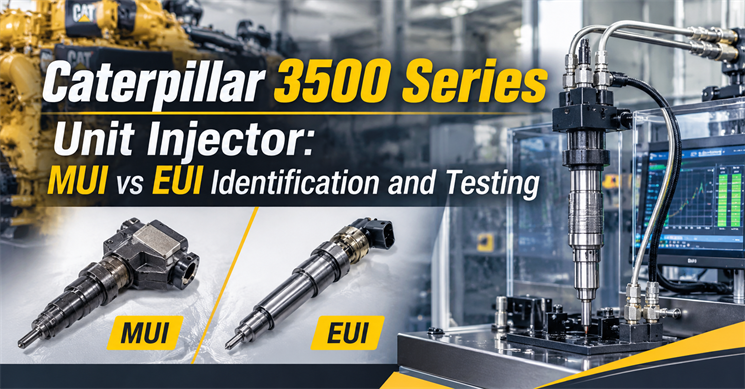
Caterpillar 3500 Series Unit Injector: MUI vs EUI Identification and Testing
If a customer writes "I need to test the injectors on my 3512", that sentence is not enough to answer. The Caterpillar 3500 family - 3508, 3512 and 3516 - has been built for decades, and the unit injector changed completely somewhere in the middle of that production run. Early engines carry a fully mechanical unit injector with a fuel rack linkage. Later engines carry an electronically controlled unit injector that needs a drive signal. The two look similar in outline, fit different engines, and cannot be serviced the same way. This guide sets out how to tell them apart and what each one needs on the bench. To match a specific engine to a configuration, send us the engine arrangement number and the injector part number: talk to our engineers on WhatsApp.
Why "3512" Does Not Identify an Injector
The 3500 series is a large displacement platform used in generator sets, mining haul trucks, marine propulsion and locomotives. Because the same block has been in production for so long, the engine model covers two different fuel systems. A 3512A and a 3512B are both called 3512, both are V12, both are measured in the same displacement class, and their injectors have nothing in common on the test side.
This matters commercially. Shops buy the wrong adapters, send an injector to a bench that cannot drive it, or rebuild a set to a specification that belongs to the other generation. The first question on any 3500 enquiry is always the same: is this MUI or EUI, and which suffix is the engine?
MUI and EUI: The Two Injectors Compared
| Feature | MUI (mechanical unit injector) | EUI (electronic unit injector) |
|---|---|---|
| Typical engines | Earlier 3500 builds | 3500 B and C series builds |
| Fuel metering | Fuel rack and control shaft position | Solenoid valve, commanded by the ECM |
| Engine control | Mechanical governor, no ECM involvement in fuelling | ECM controls injection timing and quantity |
| Drive | Camshaft and rocker | Camshaft and rocker, same physical path |
| Injection pressure | Created by the integral plunger | Created by the integral plunger |
| Setting on the engine | Fuel setting and rack synchronization | Injector height and electronic calibration |
| Bench requirement | Mechanical calibration with delivery measurement | Cam box plus injector drive signal and spray measurement |
The physical drive path is the same for both, which is exactly why they get confused. Both are pushed by the camshaft through a rocker, and both make pressure inside the injector body with a plunger and barrel. The difference is how the fuel quantity is decided - by a rack that a governor moves, or by a solenoid that the ECM fires. Everything downstream of that decision changes.
Identifying Which One You Have
Part number is the only reliable method. The mechanical injector numbering and the electronic injector numbering are separate series, and an engine swap or a rebuilt head can leave a shop with a mixture. Do not identify by appearance alone: the external body of a 3500 injector does not announce its generation, and aftermarket and remanufactured units blur the visual cues further.
The other identifiers are on the engine side. Engines with a visible fuel rack linkage running along the injector bank and a mechanical governor at the end are MUI. Engines with an ECM, engine wiring harness to each injector and a service tool connection are EUI. On the electronic engines the arrangement and serial number settle the question, and on the mechanical engines the fuel setting dimensions in the engine specification decide the calibration.
When a customer is unsure, ask for three things: the injector part number off the body, the engine arrangement number, and the engine serial number prefix. With those three, the generation and the correct specification follow. Guessing costs a set of injectors and the freight in both directions.
The Failures These Engines Actually Show
Fuel in the crankcase oil
A leaking injector body seal lets pressurised fuel into the engine oil. On a 3500 this is a serious finding, not an inconvenience: diluted oil loses film strength and the bearings pay for it. Any engine with rising oil level or falling oil pressure gets the injectors checked before anything else.
Black smoke and knock under load
An eroded nozzle tip or a needle stuck open delivers fuel that does not atomise. The symptom is heavy black exhaust, audible knock and high exhaust temperature on the affected cylinder, while the engine still starts and runs. This is the failure mode that a bench catches definitively, because spray pattern and delivered quantity are measurable.
One dead cylinder
A seized plunger or a stuck rack on an MUI, or a failed solenoid on an EUI, kills one cylinder without stopping the engine. On a V12 or V16 that is easy to miss until the operator notices vibration, smoke or a generator that will not carry rated load.
Rack binding and poor synchronization
On MUI engines the rack linkage is a mechanical chain: one binding injector rack or a worn synchronizing pin throws the whole bank out of balance. This is a linkage fault rather than an injector fault, and it is often misdiagnosed as several bad injectors at once.
Isolating the Fault Before Removing Anything
Measure exhaust port temperature at each cylinder under load. A port reading clearly colder than its neighbours points to an injector delivering little or nothing. A port running much hotter points to an injector stuck open and over-fuelling.
Cut cylinders one at a time. If disabling a cylinder makes no difference to engine speed or sound under load, that cylinder was not contributing. This isolates the problem to one position before any hardware comes off.
Check the rack linkage on MUI engines. With the engine stopped, confirm every injector rack moves freely and the synchronizing linkage is not binding. A tight rack restricts delivery and produces the same imbalance as a worn injector.
Inspect the oil and the fuel system. Rising oil level, fuel odour in the oil or a restricted filter changes the diagnosis. An engine full of diluted oil will keep failing injectors until the upstream cause is fixed.
Remove the suspect injector and test it off the engine. On-engine reasoning narrows the search; measurement on a bench is what confirms it.
Bench Setup for 3500 Injectors
EUI injectors from 3500 B and C series engines are tested on an EUI/EUP bench, which means a cam box to drive the plunger plus the electronics to command the solenoid and the instrumentation to measure delivered quantity and spray. The 3500 data and the 301C adapter group cover the common 3500 EUI part numbers, and the adapter sits in a TU-D cam box, which is standard on our comprehensive benches.
| Model | Positioning |
|---|---|
| CR919 | Full-function bench; EUI/EUP with TU-D cam box is standard, and it covers common rail injectors, common rail pumps, HEUI and piezo work as well |
| CR917S | Comprehensive bench with EUI/EUP capability and high rail pressure for common rail work |
| CR1016 | Common rail injector and pump bench with EUI/EUP on a TU-D cam box |
| CR1029 | Comprehensive performance bench for injectors and pumps, EUI/EUP by cam box |
| CR819 | Mid-range bench that covers common rail and HEUI, EUI/EUP added with a cam box |
Two points worth settling before a 3500 job is quoted. First, adapter coverage is not automatic: the 3500 EUI adapter group is a specific item, and a shop already holding a cam box of a different adapter family will need the right group rather than an improvised fixture. Second, mechanical MUI injectors are a different discipline. They are set by fuel delivery and rack travel against the engine specification rather than driven electronically, so a customer servicing both generations should say so up front - the two jobs need different equipment and the answer is not the same bench configuration. Our engineers can confirm coverage against your exact part numbers: send the list on WhatsApp.
Frequently Asked Questions
Can one bench test both MUI and EUI 3500 injectors?
Not in the same configuration. EUI testing needs a cam box plus an electronic drive signal and measurement of quantity and spray. Mechanical MUI injectors are calibrated on their mechanical delivery and rack setting against the engine specification. Treat them as two separate enquiries and specify each one against the part numbers you actually have.
How do I know whether my 3512 is a B or C series?
Read the engine arrangement number and serial number prefix off the plate, not the marketing name. The suffix is what decides the injector generation, the calibration specification and the adapter. A photograph of the engine plate plus the injector part number settles it faster than any description.
Do I need a cam box for 3500 EUI injectors?
Yes. A 3500 EUI is a unit injector: the plunger is driven by the engine camshaft, so on the bench it needs a cam box to produce the same motion. Without a cam box the injector cannot generate pressure at all, whatever electronics the bench carries.
One injector failed. Should the whole set be tested?
Yes on these engines. All the injectors on a 3500 see the same fuel, the same oil and the same duty cycle, and on MUI engines they share a rack linkage. Testing the set separates a single failed injector from a fuel quality or lubrication problem that is about to take out the rest, and the second case is the one that comes back.
About Beacon Machines
Beacon Machines builds diesel fuel injection test equipment for workshops, rebuilders and distributors. Our range covers common rail injector and pump benches, EUI/EUP testing with cam boxes and adapters, HEUI testing, mechanical pump calibration, and the tooling that goes with them. We work with buyers who need the specification matched to the actual engines in their workshop rather than a generic catalogue line, and we support installed machines with parts and technical guidance after delivery. If you are setting up capability for Caterpillar 3500 engines or adding it to an existing bench, message us on WhatsApp with your injector part numbers and engine arrangement numbers and we will come back with a concrete configuration.
 Beacon Machine Manufacturing Co.,ltd.
about beacon
PRODUCTS
contact us
TEL: 0086-18253885138
WhatsApp:+86-18253885138
Email: Janechen@beacon-machine.com
Add: High Tech Industry Zone of East Tai an city,Shandong Province,China