Language
 EN
 RU
 ES
 DE
 EL
 IT
 JA
 KO
 PT
 ID
 SR
 UK
 VI
 TH
 TR
 MS
 BE
 AR
Denso ECD-V3 V4 V5 Distributor Pump: Identification and Testing Guide
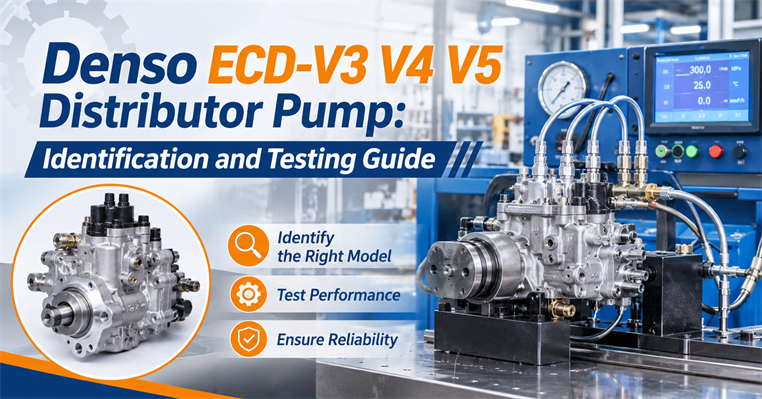
Denso ECD-V3 V4 V5 Distributor Pump: Identification and Testing Guide
Most of the distributor pumps on a workshop bench today are still mechanical, and most of the testing advice written about them assumes that. The Denso ECD-V series breaks that assumption. The ECD-V3, V4 and V5 are based on a conventional distributor pump mechanically, but a computer decides how much fuel goes in and when it is injected, and it does that by driving solenoid valves on the pump. Testing one like a mechanical pump produces the wrong answer, and condemning a good pump over a dead solenoid is a routine mistake. This guide covers how the three versions differ and what each one actually needs. If you have a pump in front of you and want to settle the configuration, talk to our engineers on WhatsApp.
What the ECD-V Series Is
The ECD-V pumps are electronically controlled versions of the distributor type injection pump. The pumping principle is unchanged: one plunger rotates and strokes, distributing fuel to each cylinder in turn, so the pump stays compact and drives off the engine as before. What changed is control. Instead of a mechanical governor and a timing device setting fuel quantity and injection point, an engine computer runs the show and actuates the pump through solenoid valves.
That places the ECD-V series between two eras. It replaced the earlier mechanical rotary pumps and it was superseded by the common rail high pressure pumps, so these units sit on a lot of older engines that are still in service and still coming into workshops. The electronics are the part that fails, and they are also the part a mechanical pump bench cannot exercise.
V3, V4 and V5: What Actually Differs
| Item | ECD-V3 | ECD-V4 | ECD-V5 |
|---|---|---|---|
| Control of fuel quantity | Spill valve (SPV) | Spill valve with an added drive unit for faster valve response | Spill valve, same approach |
| Control of injection timing | Timing control valve (TCV) | Timing control valve (TCV) | Timing control valve (TCV) |
| Fuel cut-off valve | Not fitted | Not fitted | Fitted - the V5 carries an additional fuel control valve |
| Pump speed sensing | Speed sensor on pump | Speed sensor on pump | Speed sensor on pump |
| Typical engine fitment | Earlier four and six cylinder applications | Later four and six cylinder applications | Six cylinder applications with the extra valve |
Two consequences matter on the bench. First, a V5 carries one more valve connector than a V3 or V4, so a tester or harness set up for three connectors will not run a V5. Second, the V4 introduced a dedicated valve drive unit between the computer and the spill valve, which changes the signal the pump expects. A test setup that mimics a V3 spill valve signal will not drive a V4 correctly even though the pump looks similar and fits the same bracket.
How the Valves Control the Pump
The spill valve is the quantity control. As the plunger pressurises fuel, the spill valve decides whether that fuel goes to the injector or is spilled back. Hold the valve closed for a shorter part of the stroke and less fuel is delivered; hold it closed longer and delivery rises. The computer sets the closing moment, so the pump's output follows an electrical signal rather than a mechanical governor position.
The timing control valve sets injection timing. It regulates the pressure applied to the timer piston, which moves the roller ring and therefore shifts when injection begins. Change the valve opening, and the injection point moves. This is a hydraulic chain controlled electrically, and it is the part that produces the classic complaint of a pump that delivers the right fuel quantity but at the wrong moment, giving noise, smoke or poor starting while the delivery figures all look acceptable.
On the V5, the additional fuel control valve opens and closes fuel supply, which gives the computer a way to cut fuel independently of the spill valve. This is a distinct component with its own connector, its own failure signature and its own test.
Failures Workshops Actually See
Hard starting and a no-start with fuel at the injectors
The pump is delivering but the engine will not fire, or it takes excessive cranking. A spill valve that is slow, sticking or electrically degraded, a failing speed sensor signal or a timing control valve holding the wrong pressure all produce this. The mechanical condition of the pump can be perfect and the engine still will not start.
Loud knocking and poor drivability
On these pumps this is very often timing rather than quantity. The timer piston pressure is wrong because the timing control valve is not responding as commanded, or the actual injection point does not match the target the computer is asking for. The engine diagnostics for this family specifically track the deviation between commanded and actual timing advance over a sustained period, which is a useful pointer when the symptom is knocking without a clear delivery fault.
Erratic idle and hesitation
Signal quality problems rather than mechanical wear. Speed sensor output, crankshaft position reference and the wiring between them decide whether the computer knows where the engine is. A pump that behaves differently when hot, or that improves after the harness is disturbed, points at the electrical side first.
Internal leakage and seal failure
The distributor pump body carries fuel under pressure and a rotary head, so seals eventually go. External seepage, fuel in the oil or falling delivery at temperature are the usual signs. This is the one failure that genuinely is mechanical, and it is also where a bench quantity measurement earns its cost, because a leaking pump delivers less than an acceptable-looking dry test would suggest.
Testing an ECD-V Pump
These pumps cannot be judged by a mechanical calibration alone. The quantity and timing only appear when the solenoids are driven, so the test has to include an electronic drive that reproduces what the engine computer sends. Three things must be exercised: the speed sensor input so the pump has a speed reference, the spill valve so quantity can be varied, and the timing control valve so the injection point can be commanded and observed.
Identify the version before connecting anything. V3, V4 and V5 do not share the same valve count, and the V4 expects a different spill valve drive. Read the pump number off the body and confirm which valves are physically present.
Connect the speed sensor first. Without a valid speed signal the pump has no reference and the drive will not authorise injection.
Connect the spill valve and confirm quantity responds. Vary the drive duty and watch delivered quantity change. This proves the valve is free and electrically alive.
Connect the timing control valve and exercise the timing range. The delivery should stay stable while the injection point moves. A pump that delivers but will not shift timing has a timer piston pressure problem, not a quantity problem.
On a V5, exercise the fuel control valve separately. Confirm it opens and closes fuel supply on command, and test it as its own item rather than assuming a fault elsewhere.
Run the pump at a steady reference speed and record baseline quantity and leakage. Compare across the set and against the specification before deciding on repair or replacement.
Equipment for ECD-V and Related Distributor Pumps
Because the ECD-V series sits in the same service window as the mechanical rotary pumps, most workshops end up testing both. Our benches cover that combination: a distributor pump test capability for the mechanical side, and electronic pump drive for the electrically controlled families, with the pump held and driven on the bench while quantity is measured against the specification.
| Model | Positioning |
|---|---|
| CR919 | Full-function bench; distributor pump work with measuring cylinders and injectors, plus common rail, EUI/EUP, HEUI and piezo capability |
| CR917S | Comprehensive bench with the same distributor pump option and high rail pressure for common rail work |
| CR909 | Comprehensive performance bench covering injectors and pumps, with distributor pump work available as an option |
| CR908 | Universal high pressure bench with HEUI, EUI/EUP and distributor pump capability |
| CRS900S | Common rail machine with measuring cylinder display, extendable to distributor pump testing |
One buying point worth settling early. A distributor pump bench needs measuring cylinders and a set of injectors to read delivery, so the bench configuration is not just the machine - it is the measuring side as well. Shops that intend to cover both the mechanical rotary family and the electronically controlled family should specify that in one conversation rather than buying twice. Send us the pump numbers and we can confirm what each one actually requires: send the list on WhatsApp.
Frequently Asked Questions
Can I test an ECD-V3 on a mechanical pump bench?
Not on its own. A mechanical bench drives the pump and measures what comes out, but it cannot command the spill valve or the timing control valve, so quantity and timing stay fixed and the test proves almost nothing. The pump needs an electronic drive on top of the mechanical bench.
How do I tell a V3 from a V4 or V5?
Count the valves and read the pump number. A V5 carries one more valve than the other two. The V4 uses a different spill valve drive arrangement than the V3, which matters for the tester configuration even though the pumps look alike. The pump number on the body is the only reliable identification.
Why does the pump deliver fuel but the engine still will not start?
Because delivery and timing are separate. If the timing control valve is not regulating timer piston pressure correctly, fuel arrives at the wrong point in the cycle and the engine will not fire cleanly, or it will knock and smoke. On these pumps a delivery check alone is not a pass.
Is a leaking pump body worth repairing?
Usually yes on this family, because the mechanical side is reconditionable and a leaking pump delivers less than it should, which makes every other measurement unreliable. Reseal first, then measure, so the quantity figures reflect the pump rather than its leaks.
About Beacon Machines
Beacon Machines builds diesel fuel injection test equipment for workshops, rebuilders and distributors. Our range covers common rail injector and pump benches, EUI/EUP testing with cam boxes and adapters, HEUI testing, distributor and mechanical pump testing with measuring cylinders and injectors, and the tooling that goes with them. We work with buyers who need the specification matched to the pumps actually arriving at their door rather than a generic catalogue line, and we support installed machines with parts and technical guidance after delivery. If you are setting up distributor pump service or adding the electronic side to an existing bench, message us on WhatsApp with your pump numbers and engine applications and we will come back with a concrete configuration.
 Beacon Machine Manufacturing Co.,ltd.
about beacon
PRODUCTS
contact us
TEL: 0086-18253885138
WhatsApp:+86-18253885138
Email: Janechen@beacon-machine.com
Add: High Tech Industry Zone of East Tai an city,Shandong Province,China