Language
 EN
 RU
 ES
 DE
 EL
 IT
 JA
 KO
 PT
 ID
 SR
 UK
 VI
 TH
 TR
 MS
 BE
 AR
Caterpillar C7 vs C13 Injectors: HEUI and MEUI Differences
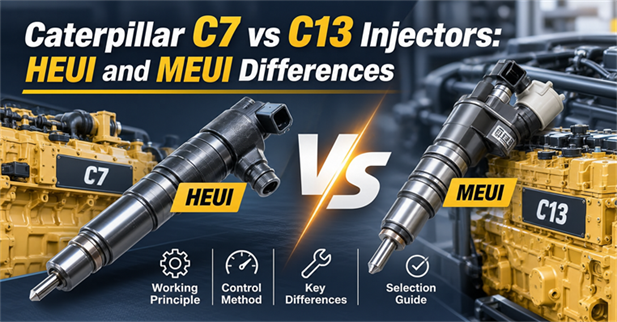
Caterpillar C7 vs C13 Injectors: HEUI and MEUI Are Not the Same System
A workshop calls in about a C7 that still smokes white after a full set of new injectors. The parts were correct, the install was clean, the engine runs exactly as badly as before. Half an hour of questioning later it turns out the machine had been re-powered with a later C13, and the injectors were ordered for a HEUI engine while the engine in the frame is a cam-driven MEUI. Two different fuel systems, two different test procedures, one part number family that looks close enough on a screen.
That mistake is not rare. Caterpillar built both architectures for years, sometimes inside the same displacement class and the same model designation, and the injectors look similar once they are out of the engine. If you test, repair or resell these injectors, the first question is never "which C-series engine is this" but "which fuel system is on it". Everything else follows from that answer. Need a second opinion on an identification, send us a message with the injector number and we will tell you what family it belongs to.
What Each System Actually Does
HEUI — Hydraulic Electronic Unit Injector. There is no injection cam lobe and no injector plunger driven by the camshaft. High-pressure engine oil is delivered to a manifold in the cylinder head, a solenoid valve on the injector admits that oil onto an intensifier piston, and the piston multiplies the oil pressure into fuel pressure. The area ratio is roughly seven to one, so a modest oil pressure becomes a working injection pressure at the nozzle. Injection timing and quantity are decided electronically; pressure comes from the oil circuit, not from engine speed. This is why a HEUI engine can build full injection pressure at cranking speed, and why a tired oil pump turns into a fuel system complaint.
MEUI — Mechanical Electronic Unit Injector. This goes back to the classic unit injector layout: a dedicated cam lobe drives a roller follower and pushrod, the pushrod works an injector rocker, and the rocker pushes the plunger inside the injector body. Pressure is generated mechanically, exactly as on a mechanical unit injector. What is electronic is the control — a fast solenoid spill valve decides when pressure is allowed to build and when it is dumped, so the ECM sets start and end of injection. There is no high-pressure oil circuit anywhere near the fuel.
The consequence for a workshop is simple and it is not obvious from the outside. MEUI has no HEUI pump, no actuation pressure sensor, no control valve to stick. HEUI has no injector rocker, no injector height setting, no lash adjustment. A technician who diagnoses one with the habits of the other will chase the wrong component for a whole afternoon.
The Practical Comparison
| HEUI | MEUI | |
|---|---|---|
| Pressure source | Engine oil into an intensifier piston | Cam lobe, follower, pushrod, rocker, plunger |
| Injector driven by | Oil pressure | Camshaft |
| Injection events | Essentially one per cycle | Pilot plus main possible |
| Cold cranking | Full pressure available immediately | Depends on cranking speed |
| Engine oil circuit | Critical — pump, valve, aeration all matter | Not used for injection at all |
| First diagnostic value | Actuation pressure, actual versus desired | Injector height and rocker condition |
| After replacement | Nothing to adjust on the injector itself | Injector height must be set with a dial indicator |
Two rows in that table cause most of the real-world pain. The first is oil: on HEUI the oil circuit is part of the fuel system, so aeration, a restricted supply, or a worn pump shows up as low pressure, white smoke, hard starting and low power. On MEUI the oil circuit is irrelevant to injection and the corresponding complaint is mechanical — a rocker that is out of adjustment or a follower that has worn.
The second is adjustment. A MEUI injector is only correct when its installed height is correct. That height is set with a dial indicator against the engine specification during installation, typically a value in the range of sixty-six to seventy-eight millimetres depending on the injector and engine. Being out by a tenth of a millimetre is enough to move both injection timing and available pressure. This is the single most common reason a MEUI engine runs badly right after a correct injector replacement, and no amount of bench testing the injector will reveal it.
How to Tell Which One You Are Looking At
Start with the engine, not the injector. With the valve cover off, the two systems cannot be confused.
Look for a high-pressure oil pump driven off the gear train, separate from the fuel system, with an electrical connector for its control valve. If it is there, the engine is HEUI. Under the valve cover there will be no injector rockers at all — the injectors sit directly in their bores.
If there is no such pump, and the valve cover reveals injector rocker arms with adjustment screws on the rocker housing, the engine is MEUI. The injector is clamped down and driven through that rocker train.
If instead a thick-walled steel tube runs the length of the cylinder head with individual high-pressure pipes branching to each injector, neither answer applies — that is a common rail engine, a third architecture with its own procedures, fed by a pump such as a CP3 or CP4 into a rail rather than into an injector.
On the model designation alone, a C7 or C9 is normally HEUI, while the later C13, C15 and C18 in ACERT form are MEUI. A C13 exists in both forms depending on build period, so the designation is a hint and never a verdict. The injector number is the only reliable single answer, and the engine layout is the only reliable visual one.
Failures That Actually Come In
HEUI: white smoke, low power, hard start
Actuation pressure is below the commanded value, usually because the pump is worn, the supply is restricted, or the oil is aerated. Compare actual against desired first — a persistent gap between the two at load is a strong signal.
HEUI: black fuel filter or rising oil level
The internal seals that separate oil and fuel inside the injector have failed. Oil in the fuel turns the filter black; fuel in the oil raises the level and thins the oil. Either direction condemns the injector.
HEUI: erratic pressure and a surging idle
The control valve on the pump is sticking from varnish. It is a valve problem, not an injector problem, and it will be misdiagnosed as injectors if nobody looks at the pressure trace.
MEUI: single-cylinder misfire with an injector circuit code
Solenoid coil failure. On a MEUI injector the solenoid is the only electronic part, and it lives in the hottest, most vibration-loaded place on the engine.
MEUI: low power across the whole engine after an injector job
Injector height was not set, or was set to the wrong specification. Also check rocker shaft and roller follower wear — both change the effective timing and pressure profile without throwing any code.
Isolating the Fault Before Pulling Anything
Read the model plate and the injector numbers together. Decide HEUI or MEUI from the hardware, not from the paperwork.
On HEUI, log actuation pressure actual versus desired at idle and at load before touching anything. On MEUI this step is meaningless — skip it and go to the mechanical checks.
On MEUI, remove the valve cover and inspect rockers, adjustment screws and followers for wear and for evidence of recent adjustment.
Compare exhaust port temperatures or do a cylinder cutout test to confirm which cylinder is actually at fault. An injector is often replaced because it was the easiest thing to reach.
Only then pull the injector, and send it to a bench configured for that family. A HEUI injector tested on a MEUI setting, or the reverse, produces numbers that mean nothing.
Bench Equipment for Both Families
Neither family can be checked properly on a plain nozzle tester, and neither can be judged by watching the spray pattern. HEUI needs an actuation oil supply with controlled pressure plus solenoid drive; MEUI needs a cam or equivalent mechanical drive with the correct stroke plus solenoid drive. These are different fixtures, not different settings on one fixture.
| Machine | Coverage |
|---|---|
| CR919 | Combined bench covering HEUI and EUI/EUP plus pump functions — the widest single-machine option |
| CR819 | Common rail injector and pump bench with HEUI coverage for C7 and C9 |
| CR908 | Universal bench for HEUI, EUI/EUP injectors and pumps |
| CR917S | High-pressure common rail bench with coding, for workshops that also service modern CR work |
| CR909 | Comprehensive performance bench for mixed fleets |
| CAT-900 | Dedicated CAT HEUI injector and 320D pump test system |
Two purchase notes. First, HEUI and MEUI adapters are not interchangeable, so decide which families you will actually see before choosing a bench, and confirm the adapter set covers them. Second, the larger Caterpillar unit injector families — the 3500 series in particular — are their own subject with their own setup, covered separately, and should not be assumed to run on the same configuration as a C13.
Frequently Asked Questions
Can one bench test both HEUI and MEUI?
Yes, if it is configured with both fixture sets and both drive types. The machine covers both; the adapters are what make it possible. Confirm the adapter list before ordering.
My C13 has no HEUI pump. Is something missing?
No. A later C13 in ACERT form is MEUI by design — the camshaft drives the injector directly and there is no oil intensifier circuit, which is also why it has no actuation pressure reading.
The injector tested fine on the bench but the engine still runs badly
Check injector height and rocker condition on MEUI engines. A bench result only describes the injector in isolation; if the installed height is wrong, a good injector will still deliver a bad injection.
Should I replace all injectors when one fails?
On HEUI, an oil-side failure often affects the set because the oil circuit is shared, so inspect the rest and the pump. On MEUI the injectors are mechanically independent, but a worn rocker train affects all of them, so check the linkage before condemning parts.
About Beacon Machines
Beacon Machines builds diesel fuel injection test equipment for workshops that service more than one generation of engine. Our range covers common rail injectors and pumps, HEUI and EUI/EUP unit injectors, and the tooling and adapters that go with them, from a single-operator bench up to multi-station industrial systems. Machines ship worldwide with documentation, adapter sets matched to the families you specify, and remote support for commissioning and diagnosis. If you are unsure which configuration covers the engines in your market, send us a message with the engine families and injector numbers you see most often and we will map them to a bench.
 Beacon Machine Manufacturing Co.,ltd.
about beacon
PRODUCTS
contact us
TEL: 0086-18253885138
WhatsApp:+86-18253885138
Email: Janechen@beacon-machine.com
Add: High Tech Industry Zone of East Tai an city,Shandong Province,China