Language
 EN
 RU
 ES
 DE
 EL
 IT
 JA
 KO
 PT
 ID
 SR
 UK
 VI
 TH
 TR
 MS
 BE
 AR
Bosch VP44 Distributor Pump: Diagnosis and Testing Guide
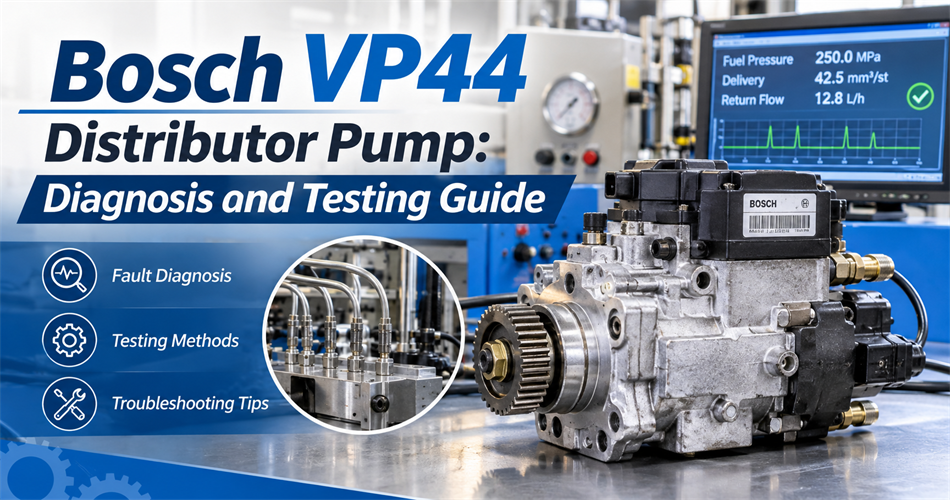
Bosch VP44 Distributor Pump: Diagnosis and Testing Guide
The Bosch VP44 is the pump that catches workshops out. It looks like a rotary distributor pump, it mounts where a rotary distributor pump mounts, and it is regularly handed to a bench as if it were one. It is not. The VP44 carries its own electronic control unit on the pump body, and every decision about fuel quantity and injection timing is made electrically by driving valves inside the pump. Test it as a mechanical pump and the numbers you get mean nothing. This guide covers what the VP44 actually is, how it fails in service, and what it takes to test one properly. If you have pumps on the bench and need the configuration settled, talk to our engineers on WhatsApp.
What the VP44 Actually Is
The VP44 is a radially plunging distributor pump with integrated electronic control. Fuel is pressurised by two opposed plungers carried in the distributor shaft, driven inwards by rollers running against a cam ring as the shaft rotates. The pressurised fuel is then distributed to each injector line in firing order by the rotation of the same shaft. This is the classic rotary distributor layout, and the mechanical parts of it are proven and durable.
What makes the VP44 different is that it is not governed mechanically. The pump body carries a control module that reads engine speed, pump angle and the driver demand, then commands the pump through solenoid valves. The control unit is matched and coded to that specific pump, which is the single most important fact for anyone servicing one.
The VP44 belongs to the electronically controlled distributor generation that ran through the Euro 2 and Euro 3 period, fitted to four and six cylinder passenger cars, light commercial vehicles and some industrial applications. It sits between the fully mechanical rotary pumps that came before it and the common rail systems that replaced it, so a large installed base is still in service and still arriving at workshops.
The Three Actuators That Run the Pump
Everything the VP44 does is set by three electrical components, and understanding the division of labour between them is what makes diagnosis possible.
The high pressure solenoid valve controls quantity. Pressure build-up only happens while this valve holds a control needle closed against the inlet passage. The control module converts the fuel quantity it wants into a time window and holds the valve closed for exactly that long. A shorter window means less fuel delivered. This is why quantity on a VP44 is fundamentally a timing decision made in milliseconds, and why a valve that is slow or sticking changes delivery without any mechanical wear at all.
The timing valve controls injection point. The cam ring inside the pump can be rotated a small amount relative to the housing, and rotating it changes when the rollers climb the cam ramps and therefore when pressure build-up starts. The cam ring is moved by an adjuster piston, spring loaded on one side and fed with pressurised fuel on the other. The timing valve regulates that pressure, so the control module can shift the cam ring to whatever position it wants. An angle sensor in mechanical contact with the cam ring reports back where it actually is.
The angle sensor closes the loop. The control module needs to know the real cam ring position, not just the commanded one, because the whole point of electronic timing is compensating for chain stretch, pump installation tolerance and changing operating conditions. Without a trustworthy angle signal the module is working blind and will default to a safe mode.
Two consequences follow directly. First, quantity and timing are independent faults, so a pump can deliver a perfect quantity at completely the wrong moment. Second, no mechanical measurement can exercise any of these three components, because all of them need an electronic driver sending them commands.
Failures Workshops Actually See
Hot start failure and long cranking
The classic VP44 complaint. The engine starts from cold and then refuses to restart once it is hot, or needs extended cranking before it fires. The high pressure solenoid valve is the usual suspect, either electrically degraded or mechanically sticky when hot, so it no longer closes for the commanded window and pressure never builds. Fuel is present at the injectors, which is exactly why the fault gets misdiagnosed as an injector or a lift pump problem.
Limp mode with a rev ceiling
The engine runs but will not exceed a limited speed, often around two and a half thousand rpm, and a warning lamp is on. This is the control module protecting itself after losing confidence in a signal. The angle sensor, the timing valve circuit or the internal wiring between the module and the valves are the places to look. A pump in this state can still deliver fuel correctly at idle, which is why a bench test that only checks delivery at one speed will pass it.
Cold start knock and rough running
On this pump family hard knocking and uneven running at low temperature is very often a timing fault rather than a quantity fault. The cam ring is not being moved to the position the module asks for, so pressure build-up starts late or early. Mechanical experience points at injectors here, and that instinct is wrong for a VP44. If delivery figures look acceptable and the engine still knocks and smokes, the timing chain is where the problem usually lives.
Control module failure and internal leakage
The control module is mounted on the pump and lives with heat and vibration, so failures are common and often heat related. Separately, the pump body carries fuel under pressure past a rotating distributor head, so seals eventually fail. External seepage, fuel dilution in the engine oil, or delivery that falls away as the pump reaches operating temperature are all signs of the mechanical side. Internal leakage also drags every other measurement down, which is why it must be dealt with before quantity is judged.
Testing a VP44 on a Bench
A VP44 test is a mechanical drive plus an electronic drive running together. The bench spins the pump and measures what comes out; the electronic side supplies the speed and angle signals the pump needs and commands the valves. Leave out the electronic side and the pump either will not authorise injection at all or will sit in a fixed safe state, and neither result tells you anything about the pump's condition.
Identify the pump and its control module before connecting anything. Read the pump number off the body and record the module type. VP44 units are built in several variants, and the module fitted to a pump is matched to it. Confirm what you are holding before assuming which harness applies.
Supply the speed and angle signals first. Without a valid pump speed reference and angle feedback the control module will not run normally. Verify the signal is being seen before going any further, because a missing reference looks exactly like a dead pump.
Command the high pressure solenoid valve and watch quantity respond. Vary the commanded window and confirm delivered quantity tracks it. A valve that responds slowly, sticks at one end of its travel, or fails to hold at temperature is a valve fault, not a pump fault, and needs to be separated before anything else is measured.
Exercise the timing range and watch the angle feedback. Command timing across its full range and confirm the reported cam ring position follows. Delivery should stay stable while the injection point moves. A pump that delivers but will not shift timing has a timing valve or adjuster piston problem.
Measure quantity at several steady speeds, with the pump at temperature. A single point check at idle passes pumps that fail in service. Compare across speed points and against the specification, and note whether delivery drifts as the pump warms.
Check return flow and internal leakage last. Leakage explains a pump that under-delivers everywhere and looks electrically healthy. Reseal before condemning a pump on quantity alone, then measure again so the figures reflect the pump rather than its leaks.
Equipment for VP44 Testing
VP44 work needs two capabilities that are usually bought separately and should be specified together: a bench with measuring cylinders and a set of injectors to read delivery, and an electronic pump drive that can generate the speed and angle signals and command the valves. Buying the bench first and discovering the electronic side is missing is the most common configuration mistake on this pump family.
| Model | Positioning |
|---|---|
| CR919 | Full function bench. Distributor pump work with measuring cylinders and injectors, alongside common rail, EUI/EUP, HEUI and piezo capability |
| VP44 Tester and EDC Simulator | Standalone electronic drive for four and six cylinder VP44 pumps, for shops that only need the electronic side or want a second drive station |
| CR917S | Comprehensive bench with the same distributor pump capability and high rail pressure for common rail work |
| CR909 | Comprehensive performance bench covering injectors and pumps, with distributor pump work available as an option |
| CR908 | Universal high pressure bench with HEUI, EUI/EUP and distributor pump capability |
| CRS900S | Common rail machine with measuring cylinder display, extendable to VP37 and VP44 pump testing |
Send us the pump numbers and engine applications you actually see and we will confirm which configuration covers them, including the harnesses and fixtures: send the list on WhatsApp.
Frequently Asked Questions
Can I test a VP44 on a mechanical pump bench?
Not on its own. A mechanical bench can spin the pump and measure delivery, but it cannot command the high pressure valve or the timing valve, so quantity and timing stay wherever the pump defaults to. The measurement then reflects a safe mode rather than the pump's real behaviour. The VP44 needs an electronic drive in addition to the mechanical bench.
How do I tell a VP37 from a VP44?
By the control module and the pump number, not by eye. Both are rotary distributor pumps and both carry electronics, so the housing looks similar. The reliable route is to read the pump number off the body and confirm the module type fitted to it, then match that against the harness and drive you intend to use.
Does a hot no-start always mean the pump is finished?
No, and that matters commercially. A hot no-start is very often the high pressure solenoid valve or the control module rather than the pumping elements, and both of those are serviceable items. A bench test that isolates quantity control from the mechanical side tells you which it is, so a pump is not condemned over a valve.
Should the control module be repaired or replaced?
That depends on the module type and what has failed inside it, and it is a question for the electronics specialist rather than the pump bench. What the bench must establish first is whether the mechanical side of the pump is sound, because repairing a module onto a pump with failed seals or worn plungers wastes the repair. Test the pump mechanically, then decide on the electronics.
About Beacon Machines
Beacon Machines builds diesel fuel injection test equipment for workshops, rebuilders and distributors. Our range covers common rail injector and pump benches, EUI/EUP testing with cam boxes and adapters, HEUI testing, distributor and mechanical pump testing with measuring cylinders and injectors, electronic pump drives and simulators, and the tooling that goes with them. We work with buyers who need the specification matched to the pumps actually arriving at their door rather than a generic catalogue line, and we support installed machines with parts and technical guidance after delivery. If you are setting up distributor pump service or adding the electronic side to an existing bench, message us on WhatsApp with your pump numbers and engine applications and we will come back with a concrete configuration.
 Beacon Machine Manufacturing Co.,ltd.
about beacon
PRODUCTS
contact us
TEL: 0086-18253885138
WhatsApp:+86-18253885138
Email: Janechen@beacon-machine.com
Add: High Tech Industry Zone of East Tai an city,Shandong Province,China